On August 22, the Horgos Compressor Station, operated by China Oil & Gas Pipeline Network Corporation, delivered a cumulative total of more than 600 billion cubic meters of natural gas.
This volume of natural gas can release the same amount of energy as approximately 798 million tons of standard coal, but reduces carbon dioxide emissions by 877 million tons and dust emissions by 435 million tons.
The station is responsible for transporting natural gas from Central Asia and coal-based gas from Ili in Northwest China’s Xinjiang Uygur Autonomous Region to central and eastern China.
With an annual transportation capacity of 60 billion cubic meters of natural gas and the total capacity of the natural gas compressors exceeding 240 megawatts, the station ranks first in Asia in terms of single-station installed capacity.
Via the trunk pipelines of the West‑to-East Gas Transmission Project, the gas supply has reached 27 provinces, municipalities and autonomous regions across China and the Hong Kong Special Administrative Region. It reliably meets the energy needs of more than 500 million people, underpins industrial production in the Yangtze River and the Pearl River deltas and continuously optimizes China’s energy consumption mix.
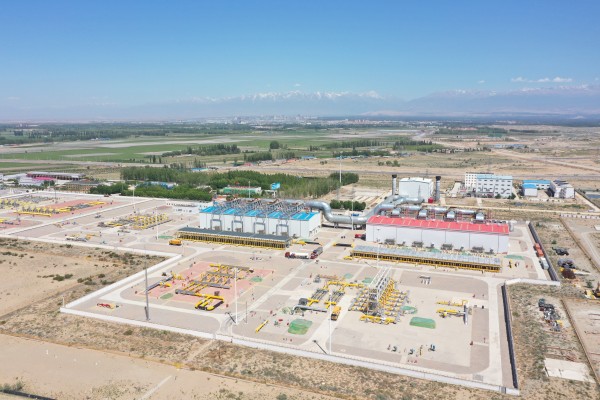
A view of the Horgos compressor station in Northwest China's Xinjiang Uygur Autonomous Region, which is the starting point of the second and third lines of China's West-to-East Gas Transmission Pipeline. [Photo/sasac.gov.cn]
Using waste heat from the gas-turbine-driven compressor units, the station has built the country's first waste heat power generation project at a natural gas transmission station, achieving zero direct emissions from the station's units, with an average annual power generation of more than 65 million kilowatt-hours.
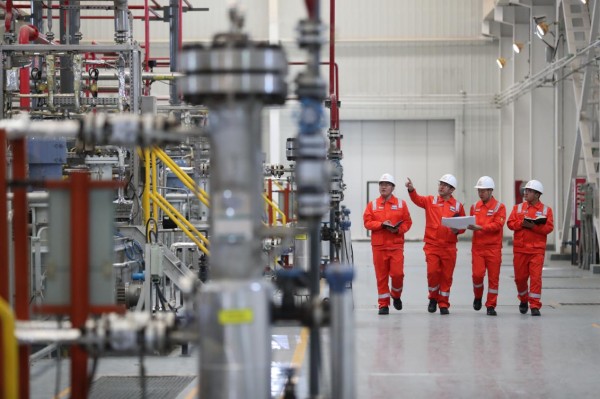
Workers at the compressor station conduct daily inspections. [Photo/sasac.gov.cn]
Since 2025, the Horgos Compressor Station has scaled up investment in digital technologies and improved its intelligent operation and maintenance system. It enables real‑time monitoring of the operating status of units and pipelines and early warning of potential risks, shifting equipment maintenance from post‑incident response to preventive control.
The Horgos Compressor Station safely and efficiently transfers gas in an eco‑friendly manner, deepening China‑Central Asia energy cooperation, safeguarding national energy security and advancing high‑quality Belt and Road cooperation.
(Executive editor: Zuo Shihan)