China has begun trial operation of the High Intensity Heavy-ion Accelerator Facility (HIAF) following its completion and official technological acceptance.
The HIAF, a key national mega-science project, is the world’s first advanced heavy-ion research facility that combines a superconducting linear accelerator, a synchrotron and a storage ring. It was built by China Construction Eighth Engineering Division Corp., Ltd., a subsidiary of China State Construction Engineering Corporation.
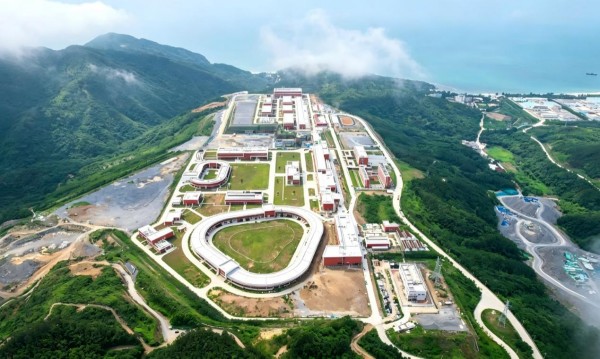
A panorama of the High Intensity Heavy-ion Accelerator Facility. [Photo/sasac.gov.cn]
The project, situated in the coastal mountains of Huizhou City, Guangdong Province, imposed stringent requirements on structural integrity, flatness, and construction precision, as even tiny cracks or water seepage could damage its core facilities.
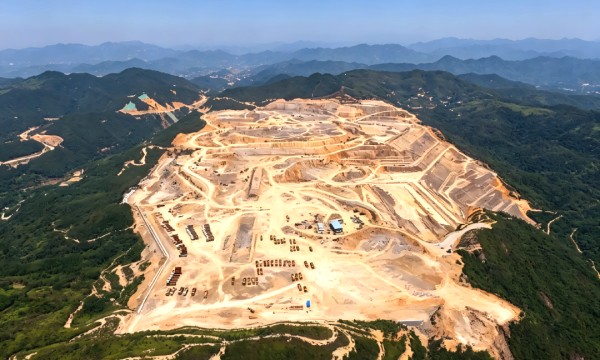
A view of the construction site before facilities were established. [Photo/sasac.gov.cn]
The project team established a comprehensive anti-seepage system that could effectively intercept and drain fissure water and precipitation. It adopted finite element analysis software for simulation calculations, addressing core technical challenges including the placement of massive, 4.5-meter thick concrete and the stability control of ultra-long tunnels.
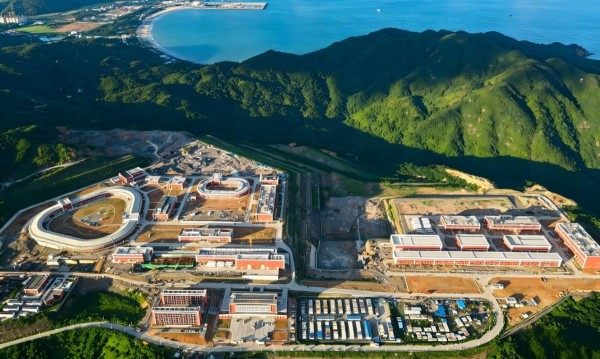
A panorama of the HIAF. [Photo/sasac.gov.cn]
Collaborating with the Chinese Academy of Sciences, the project team employed a digital pre-assembly approach. All components, such as electromechanical pipelines and intelligent equipment, are virtually assembled on computers before on-site installation. This innovative method has shortened the overall installation period to just eight months, compared with the international average of two to three years.
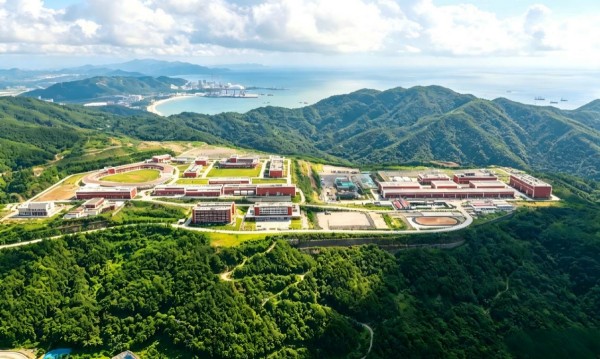
A panorama of the HIAF. [Photo/sasac.gov.cn]
The HIAF, which is equipped with the world’s highest pulsed heavy-ion beam intensity, can help researchers study microscopic structures through particle fragments produced by beam bombardment. The “super microscope” will boost interdisciplinary development between nuclear energy and multiple other fields, such as aerospace, medical treatment and agriculture.
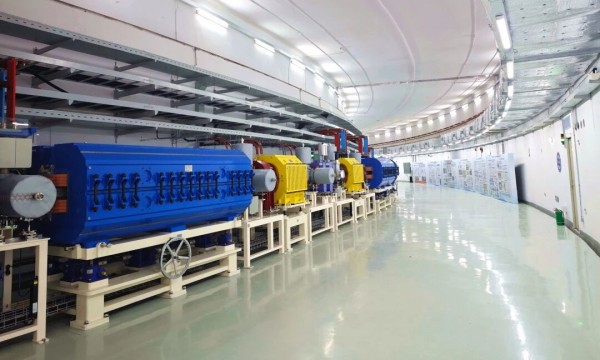
The booster ring of HIAF. [Photo/sasac.gov.cn]
(Executive editor: Zuo Shihan)