The 11th Africa Tech Challenge (ATC) opened at Weifang Vocational College in East China’s Shandong Province on August 28, attracting 68 contestants from six African countries that include Cameroon, Ghana, Rwanda, Senegal, South Africa and Zimbabwe. The participants are all international students in China under the Future of Africa: China-Africa TVET Cooperation Program.
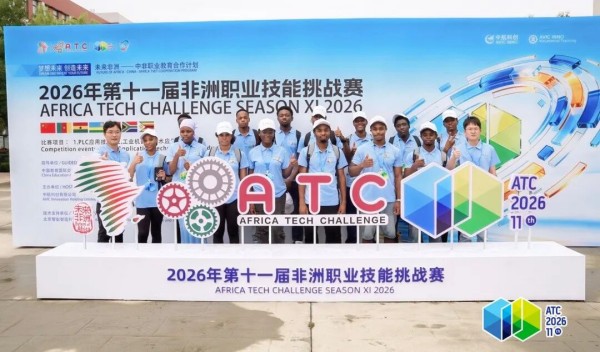
A group photo of participants of the 11th Africa Tech Challenge. [Photo/sasac.gov.cn]
This year’s edition of ATC features two events: the application of industrial robots and programmable logic controllers. It will provide contestants with two weeks of systematic training to sharpen their professional skills prior to the final competition. Awards will be presented at the World Vocational and Technical Education Development Conference to be held in Tianjin in October.
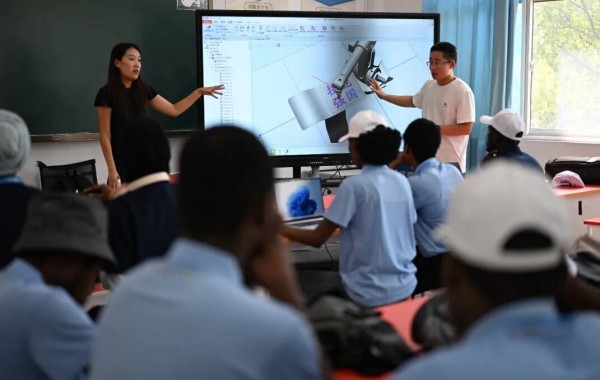
Lecturers give technical lessons to participants. [Photo/sasac.gov.cn]
In 2023, the ATC was incorporated into the framework of the Future of Africa: China-Africa TVET Cooperation Program, further expanding its reach and influence. It has become a crucial platform for youth in China and Africa to exchange skills, and has served as a vivid example of China-Africa efforts in advancing the UN 2030 Agenda for Sustainable Development and the African Union’s Agenda 2063.
Vocational and technical education in Africa is an important initiative of Aviation Industry Corporation of China, Ltd, (AVIC) to implement China’s cooperation strategies with Africa and fulfil its overseas social responsibilities. AVIC Innovation Holding Limited, an AVIC subsidiary, undertakes specific programs, aiming to cultivate skilled talent for Africa’s industrialization and modernization drive. The company has built and renovated over 180 vocational schools across multiple African nations and annually trains more than 20,000 teachers and students, enabling African youth to pursue their personal growth and drive local economic and social development.
First launched in 2014, the ATC is designed to foster high‑level skilled personnel, and it has benefited nearly 2,000 participants. Thirty outstanding contestants have been awarded full scholarships to pursue studies in China, making the ATC an important gateway for African youth to learn about and understand China.
Going forward, AVIC will continue to deepen its engagement in vocational and technical education in Africa, build the ATC into a flagship program, and bridge the gap between vocational education and industrial development. It will contribute greater strength to building an all‑weather China‑Africa community with a shared future for the new era.
(Executive editor: Zuo Shihan)